How Overmark works.
Learn how to launch a token, trade, place orders and mint NFTs on Overmark. These guides cover the current contracts, fee distribution and protocol permissions.
Updated 11 October 2026 · Contracts are unaudited
Overview
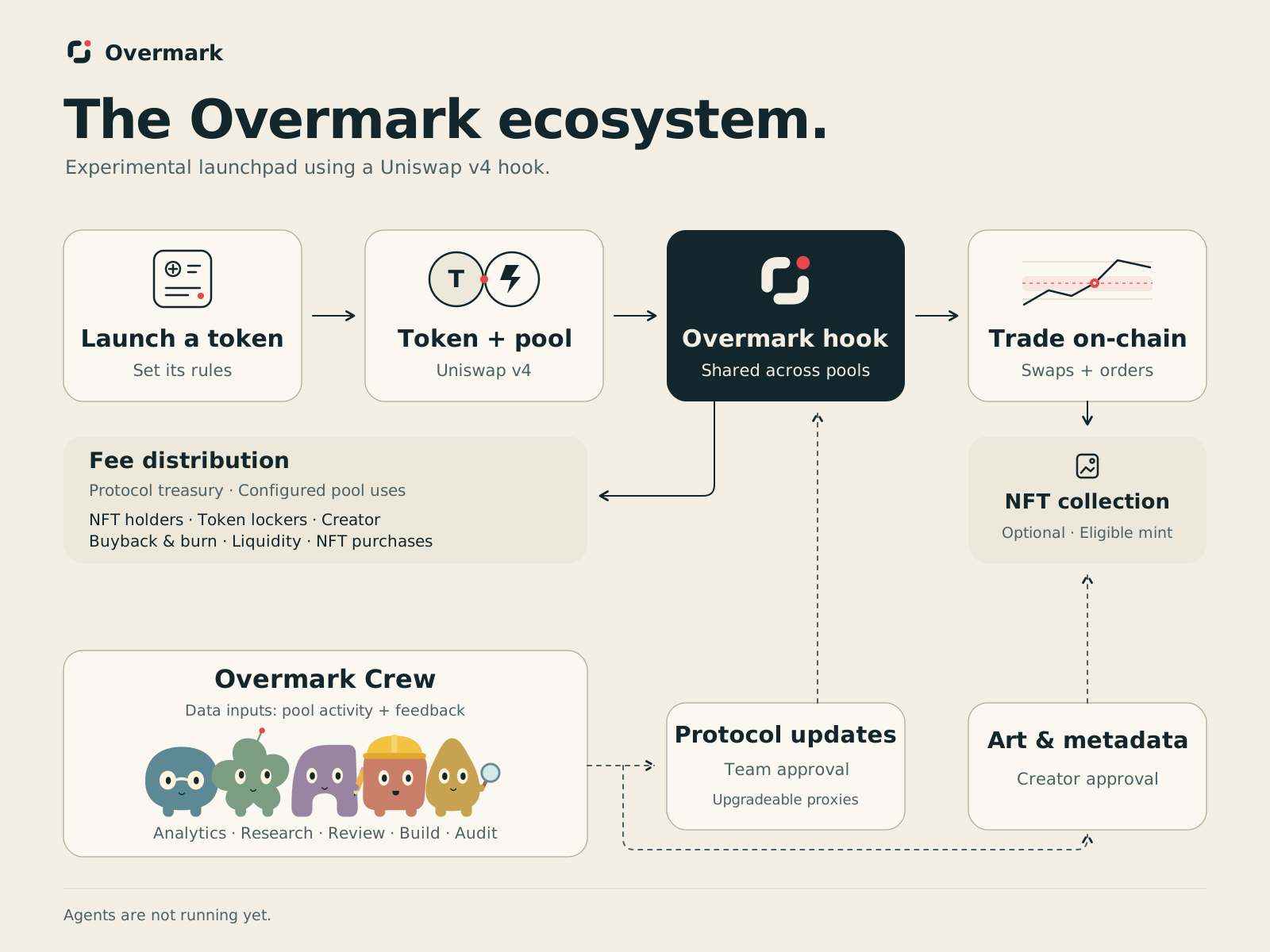
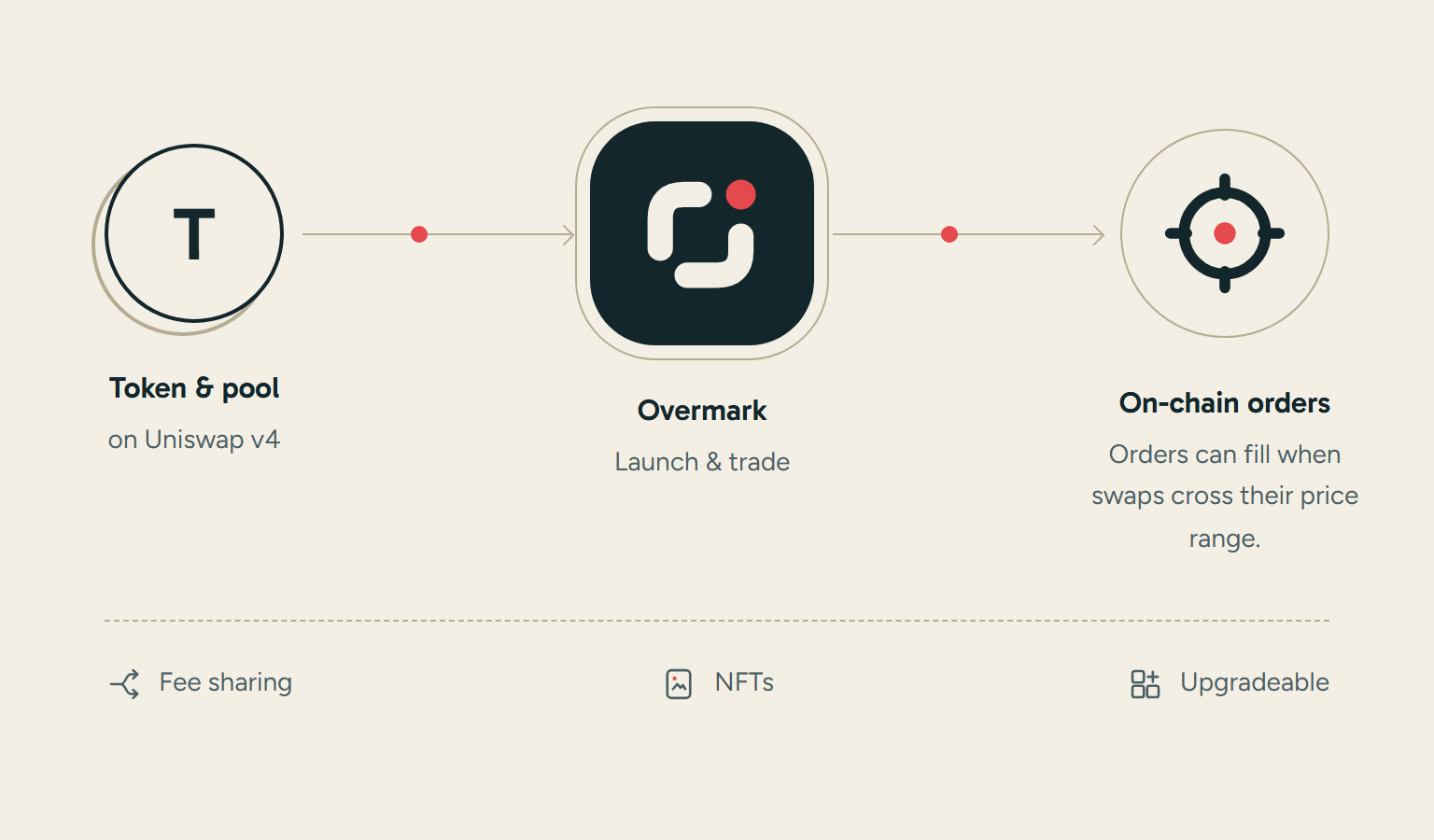
Each launch creates a token and one Uniswap v4 pool. WETH is the default quote currency; other supported currencies may be available. The shared Overmark hook connects swaps to orders, fees and optional NFT minting.
- On-chain orders. Place buy orders below the current price or sell orders above it. Automatic orders are available on every pair. Stop orders use a separate contract and require execution.
- Swap execution. Swaps fill buy and sell orders when they cross the order's price range, then process queued wallet payments in bounded batches.
- Swap fees. The protocol receives 10% of the swap fee. The pool owner configures how the remaining 90% is allocated.
- Optional NFTs. An eligible exact-amount buy can mint an NFT in the same transaction.
Rewards contracts handle fee distribution and can also receive NFT resale royalties when marketplaces pay them to that contract. The NFT collections and holders' vote have their own contracts; they are not functions inside the hook.
Overmark is the shared protocol used by projects launched here. CREW is its first project, with its own token, NFT collection and holder vote. Those project-specific settings and benefits do not apply to every launch.
Launching a token
Choose a token name, ticker and launch settings. The launch transaction creates the token and pool. Optional approvals, profile and NFT artwork settings may require additional transactions, listed in the form before you launch.
| Supply | 1,000,000,000 tokens at launch. No additional tokens can be minted. Burns reduce the total supply. |
| Reserved supply | Optional. Up to 80% can be kept out of the pool. It is either sold in public orders, or sent to a wallet you name. See below. |
| Trading pair | Choose ETH or a listed quote token. The pair is fixed at launch. Stock-token pairs use raw ERC-20 units, rather than multiplier-adjusted share amounts. Automatic orders are available on every pair. On a pair that is not ETH, placing one also deposits WETH for gas. Public reserve orders require an ETH pair. |
| Liquidity | The current launchpad contract has no liquidity withdrawal function. The token page shows TVL as both sides of the pool at the current price, with quote-token and launched-token balances listed underneath. A pool launches holding only the launched token, so the quote side starts at zero and grows as people buy. Protocol upgrades remain possible; see What can change. |
| Market cap estimate | MCap is the current price multiplied by the current total supply. Burns reduce that supply. This estimate includes tokens in the pool, reserves and locks; it does not use an independently verified circulating supply. The value is shown in USD when the pair has a configured price feed, otherwise in quote-token units. |
| Swap fee | 0% to 3%, chosen by you. You can change it later, within the same range, until you lock the token's settings. |
| Starting market cap | Initial price multiplied by the total supply. For an ETH pair, the form defaults to approximately 1.85 ETH and offers a slider from 0.5–50 ETH. The contract accepts a wider tick range, approximately 0.04–110 ETH. This is a valuation, not a payment. |
| First buy | Optional. You can buy in the launch transaction itself, before anyone else can trade. It pays the fee like any swap. |
| Cost | Network gas, plus any optional initial purchase. No quote-currency deposit is required to create the pool. |
Opening times
A launch can name when its pool starts to take swaps and when its NFTs start to mint, each at most seven days ahead. Until trading opens the pool refuses every swap except the creator's own first buy, which is made inside the launch transaction and is visible on chain. Until minting opens, the exact buy only buys the tokens. Both are set in the launch transaction itself, so nobody trades or mints in between.
Afterwards the pool's owner can bring either time forward, never put it off, and a pool that has opened cannot be closed again. Both times are shown on the token's page.
Reserve allocation
Reserved tokens can be sent to a wallet or split equally into public sell orders at selected prices, approximately 2–100 times the initial price. A wallet-held reserve can be sold at any time.
- The orders sit in the token's order book, so everyone sees at which prices the reserve will be sold, and how much at each.
- New reserve orders send net WETH to the wallet you named through the on-chain payout queue. They are available on an ETH pair. Older reserve orders still require collection, which anyone can submit.
- You can take an unfilled order back, which returns its tokens to that wallet. That is public too: the token's page shows each order as waiting, filled or taken back.
Swapping
Swaps use Uniswap's router. ETH pairs accept and return ETH; other pairs use their quote token. The quote includes the pool's fee and any orders filled by the swap.
Slippage tolerance sets the minimum received or maximum paid relative to the quote. If the transaction exceeds that limit, it reverts. Network gas still applies.
Other pools
By default a token launched here can be traded anywhere, like any other token. Trades in a pool other than its Overmark pool do not pay that pool's fee, so the pool's owner can close the token to three kinds of pool, each on its own: pools built like Uniswap v2, pools built like Uniswap v3, and Uniswap v4 pools that do not run the Overmark hook. The token then cannot be supplied as liquidity to, or sold in, a pool of that kind. The choice is offered at launch under Advanced, and can be changed until settings are locked.
A closed kind is refused only on the way in. Transfers between wallets are never checked, and tokens already in a pool can always be withdrawn. The check recognises a pool by how it describes itself, so an exchange built differently is not covered, and neither is a pool for a token that wraps this one. In Uniswap v4, tokens a trader keeps inside the pool manager do not pass the check. Closing a kind is a deterrent, not a guarantee.
If the check itself fails for any reason, the token lets the transfer through: a fault in the hook cannot freeze a token.
Buy, then sell part higher
After a buy, you can allocate 25%, 50% or 100% of the received tokens to a sell order at 2, 5 or 10 times the post-swap price. The allocation includes the execution tip. Approvals and order placement require additional wallet confirmations. The order can be cancelled before it fills.
Processing a new order's wallet payment earns an output tip, transferred directly during that payment in the pair's output currency. The order also reimburses bounded fill and payment work in WETH. An ETH pair takes that WETH from the order, up to 1%. Any other pair uses the WETH deposited when the order was placed. On Robinhood, a share of the transaction's L1 data fee is included without charging that fee twice across owners or price groups. The sender still pays network gas in ETH upfront; the budget and batch limits mean compensation may cover only part of that cost. Tips from older orders remain claimable under Your orders.
Order types
Buy and sell orders are held in the pool. Automatic orders are available on every supported pair. Stop orders are held in a separate contract.
| Order | What it does | Paid in |
|---|---|---|
| Sell above | Sells your tokens for the pool's currency once the price has risen through your target. Often called take profit. | Tokens |
| Buy below | Spends the pool's currency on the token once the price has fallen through your target. | The pool's currency |
| Stop | Sells your tokens at the market price if the trigger is still reached after five Ethereum confirmation blocks. | Tokens |
Price steps
The pool's prices are divided into steps of about 2%. An order sits in one step, and fills at about the middle of it. Orders in the same step fill together. The minimum is set in the pool's currency. For an ETH pair the default is 0.001 WETH of traded value, after the buy gas reserve. A pool can hold up to 64 active automatic order groups, counting both directions.
After it fills
New orders send net proceeds to your wallet automatically, with up to eight payout attempts per swap. Remaining payments continue during later swaps. If activity stops, anyone can submit a Process payouts transaction; without a transaction, the queue waits. Failed transfers remain queued for retry. Older orders still use collection.
Before an order fills, you can cancel it to recover its remaining assets, including unused WETH set aside for gas. A price range that has partly traded can return a mix of the pool's currency and the token.
Stops
Stop execution requires two transactions. Anyone can arm a stop when the price reaches its trigger, then execute it at least five Ethereum confirmation blocks later if the price is still beyond the trigger. On Robinhood, these are Ethereum blocks rather than its faster L2 blocks. If the price recovers, the stop can be disarmed. The sale uses the market price at execution; neither execution nor a sale price is guaranteed.
Order execution
Buy and sell orders use liquidity at a selected price range. A buy swap fills sell orders as the price rises through them; a sell swap fills buy orders as it falls through them. These orders do not require a separate keeper.
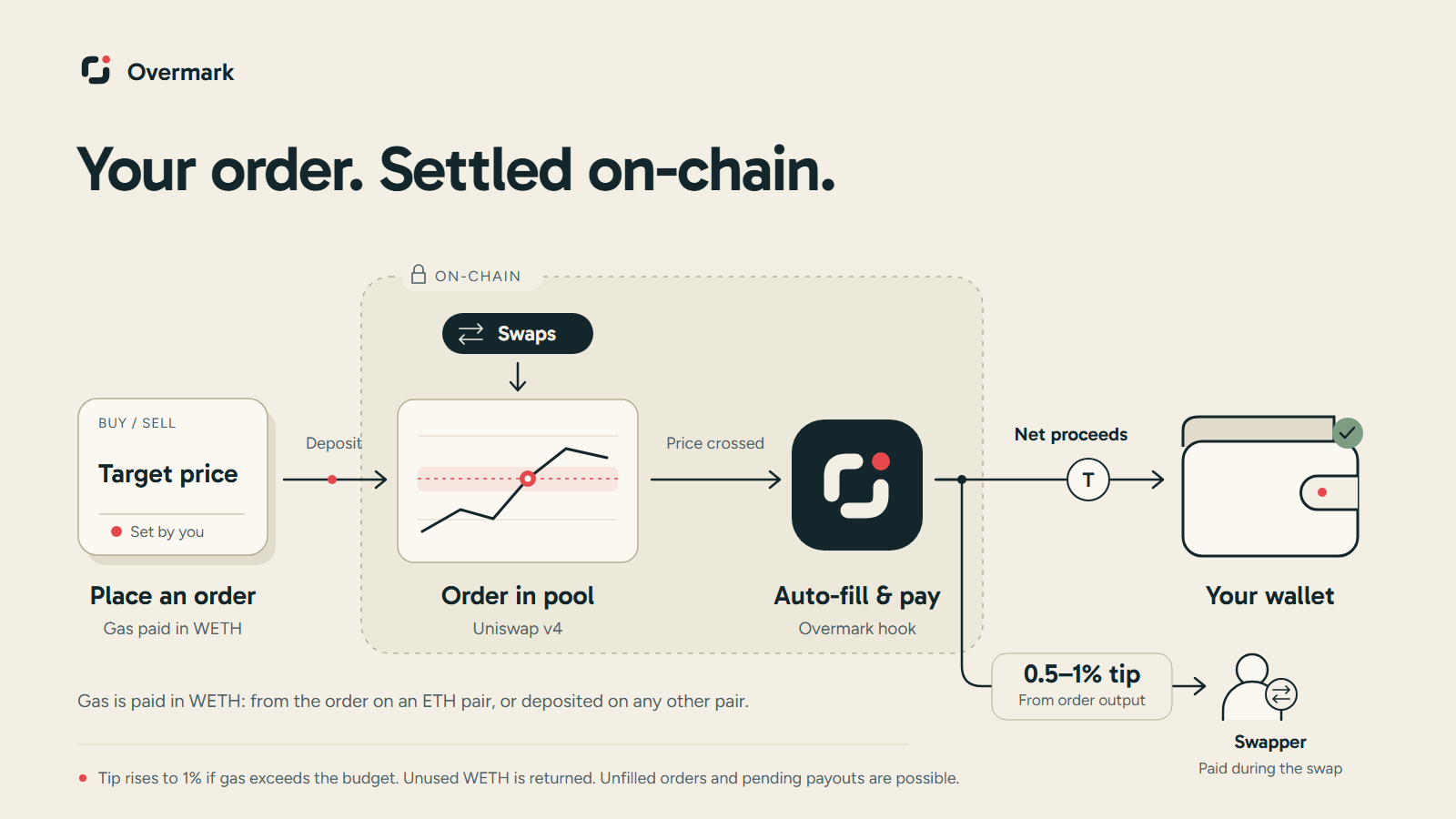
| Tip on a new sell or buy order | 0.5% of gross output, or 1% if the calculated gas compensation exceeds the budget. Paid directly to whoever processes that wallet payment. |
| Gas compensation | Paid in WETH. On an ETH pair, a buy reserves 1% of the entered WETH and trades the rest, and a sell deducts it from WETH output, up to 1%. On any other pair, the order deposits WETH for gas and trades the full amount. Unused WETH is returned. The tip stays in the pair's output. |
| Reward for running a stop | 0.3% of the WETH the stop receives, to the wallet that ran it. |
On-chain orders
Overmark orders deposit assets into the pool at a selected price range. This differs from signed orders that keep assets in your wallet until an external executor fills them.
| A signed, off-chain limit | An order on Overmark | |
|---|---|---|
| What it is | A message you sign. It is kept off chain until someone fills it. | Liquidity placed in the token's pool, at your price. |
| Your tokens | Stay in your wallet until the order fills. | Are held by the contract from the moment you place the order. |
| Cost to place | Usually no gas, only a signature. | Wallet gas, plus an output tip. An ETH pair includes capped WETH gas in the entered amount. Any other pair deposits WETH for gas separately. |
| Execution | An external executor submits the order. | A swap crosses the order's price range. |
| If the price is reached | It may still go unfilled. | It fills once the price has passed through its step. |
| How long it lasts | Until an expiry you choose. | Until it fills or you cancel. There is no expiry. |
| Visibility | Depends on the service storing the order. | Public on chain and in the order book. Chart markers are optional. |
| Price | Any price. | One of the pool's steps, about 2% apart. |
Overmark orders require gas and hold deposited assets until filled or cancelled. Execution depends on swaps crossing the selected price range rather than a separate order executor.
For a token launched here, the orders on its Overmark page are the ones the pool itself fills. A limit placed through another app is that app's order, and whether it fills is outside Overmark's control.
Swap fees
The swap fee applies to buys and sells. It is set at launch between 0% and 3%, and the pool owner can update it until settings are locked. The current fee is shown on the token page.
| Protocol | 10% of the swap fee. |
| Pool allocation | 90% of the swap fee, allocated to the creator or configured uses below. |
For a swap with a fixed input amount, the fee is deducted from the output. For a fixed output amount, it is added to the input. For example, a buy with a fixed ETH payment pays the fee in tokens.
Fee permissions
The pool owner can update its swap fee until settings are locked. The protocol share, fee ceiling and order tip are defined in the hook's logic; changing them requires a team-controlled upgrade.
Hook upgrades currently have no waiting period and apply to existing pools. Changes are recorded on chain. See Protocol upgrades.
Buy limits
A creator can set a cumulative ordinary-buy allowance for each transaction-sending wallet while minting is underway. It is a percentage of the initial supply. CREW uses 0.5%, or 5 million CREW per wallet. NFT mints are excluded. The limit ends at the selected mint progress or block duration; the pool owner can remove it earlier from Manage, even after settings are locked.
- It applies to buys only. Selling is never capped, and selling does not restore the allowance.
- Splitting one wallet's purchases across swaps does not reset its allowance. Different wallets have separate allowances. Relayed and account-abstraction transactions share their relayer or bundler's allowance. One person can use several wallets.
- New limit buy orders wait until this allowance ends, because liquidity-order fills do not invoke the swap-buy check. Sell orders remain available. The allowance covers this launch pool, not token holdings or trades on other exchanges.
NFT minting
A token can have its own NFT collection with a fixed size. An eligible purchase of the exact mint amount mints one NFT in the same transaction. The NFT is sent to your wallet; there is no separate claim.
CREW uses Mint & lock. You pay with ETH in that transaction. You do not buy CREW first. The contract wraps the ETH, buys 33,333.333 CREW, mints the NFT, and locks every one of those tokens for 30 days. ETH that is not spent comes back. This lock has the same 1.5× weight and locker fee share as the standard 30-day tier, separate from the NFT holder's fee share. After the lock ends, you can unlock the tokens to your wallet. Buying, minting and locking succeed together or the whole transaction reverts. Ordinary CREW buys remain liquid and do not mint an NFT. A lock that was already recorded keeps its stored unlock time.
- On an ETH pair you pay ETH in the mint transaction. The contract wraps it, buys the exact mint amount, and mints the NFT. You do not buy the token first, and unspent ETH is returned. A pair priced in another token asks you to approve that token first; the mint then pulls it.
- A new collection divides the exact mint amount into a burned share, a locked share, and the rest sent to your wallet. The creator chooses a 30, 90, or 180 day lock, with 1.5×, 2×, or 3× weight. The launch form defaults to 50% burned and 50% to the wallet. You pay for the mint amount, plus the swap fee and gas. A locked share appears on the Rewards tab and can be unlocked after its date. A lock share is available only on an ETH pair. Older collections can still charge an additional burn on top of the mint amount: you receive the mint amount and also pay for the extra tokens, which are burned.
- One NFT per wallet, with one mint per configured block window. Mint intervals on Robinhood count its L2 blocks; other chains use their native blocks. The countdown time is an estimate, and minting opens only after the required blocks have passed.
- Artwork is assigned at mint unless the creator chose delayed reveal. Delayed artwork uses a completed block after minting; until revealed, the NFT shows the creator's placeholder. These block-based seeds do not provide secure randomness.
- The pictures are the creator's own. See NFT art.
- A new collection starts with royalty enforcement on (ERC-721C), where the royalty registry exists on the network. A marketplace can then move its NFTs only in a sale the registry allows, which is one that pays the royalty; a holder can always send their own NFT. The creator finishes the setup on each marketplace, for OpenSea under Creator Earnings in OpenSea Studio, and can turn enforcement off or on again from Manage. Marketplaces that do not support it cannot sell an enforced collection.
Overmark's own collection is the Crew: 333 NFTs on the CREW token. Its picture is drawn on chain from the mint hash. Clan and body shape come from that hash. There is no reserved count for each clan. See Crew artwork for the formula.
NFT artwork
A new collection has no images until its creator provides them. You prepare the images and their metadata, upload both, and give the launch page one link.
Two uploads
The images and the metadata are uploaded separately, each as its own folder. Neither goes inside the other, and each gets its own link.
1. images/ | 0.png, 1.png and so on, one finished image per NFT. Upload this first, because the metadata files need its link. |
2. metadata/ | 0.json, 1.json and so on, one per NFT. Upload this second, and paste its link on the launch page. |
- The folder names are yours to choose. Only the file names inside them matter.
- Files are numbered from 0, with no gaps: a collection of 333 runs from
0to332. - Each
.jsonfile holds aname, adescription, animage(the full link to its image in the first upload, such asipfs://…/0.png) andattributes, in the form marketplaces read. - The link you paste ends with a slash, for example
ipfs://bafy…/.
Where to upload
Any service that keeps a folder on IPFS or Arweave, such as Pinata, Lighthouse, Filebase or ArDrive. Upload each folder itself, not a zip and not the files one by one, so every file keeps its name. Services differ in what they offer for free and how many files they take, so check before you choose one.
The files live where you host them. An ipfs:// link names files by their content, so they cannot be swapped for others, but someone has to keep hosting them.
Artwork assignment
- Immediate artwork uses the preceding block hash and the mint's identifiers. It provides variation, not secure randomness. Buyers and block producers can influence artwork assignment.
- With delayed reveal, artwork uses the hash of the block after minting, once that block is complete. On Robinhood, this is an L2 block hash. A reveal after the hash expires uses a recent hash instead. Anyone can reveal an NFT; a later mint also reveals the previous NFT when eligible. Delayed reveal does not guarantee fair or unpredictable assignment.
- Each NFT is dealt one number from those not dealt yet, like cards from a shuffled deck. The contract cannot deal the same number twice, so no two NFTs share a file.
- Crew's renderer draws from the mint hash. If that picture matches one already minted, it tries another seed. The mint does not finish on a repeated picture.
File uniqueness does not guarantee visual uniqueness. The creator is responsible for preparing distinct artwork.
Crew artwork
Every Crew NFT is drawn by a contract from one hash fixed at mint. There are no image files and no metadata files: the name, the traits and the picture are produced on chain each time they are read, and the same hash always gives the same picture.
1. The mint hash
seed = keccak256(previous L2 block hash, chain ID, collection address, NFT number, minter)
The seed is stored with the NFT and does not change afterwards.
2. Traits
The seed is hashed once more, h = keccak256(seed), and each trait reads one byte of h.
| Trait | Formula | Result |
|---|---|---|
| Clan | h[0] % 5 | Speck, Ping, Nib, Tuck or Peek |
| Body | h[1] % 8 | One of eight body shapes for that clan, 40 in all |
| Build | h[2] % 6 | Regular, Tall, Wide, Compact, Large or Slender |
| Width | base + (h[3] % 19 − 9) × 2 | The build's base width, 18 units either way |
| Height | base + (h[4] % 15 − 7) × 2 | The build's base height, 14 units either way |
| Eye spacing | 62 + h[5] % 23 | Capped at 30% of the width |
| Eye size | 18 + h[6] % 7 | Capped at 10.5% of the width |
| Gaze | h[7] % 3 − 1 | Left, centre or right |
| Expression | h[8] % 6 | Calm, Happy, Wink, Focused, Curious or Grin |
| Tilt | h[9] % 19 − 9 | The angle of Nib's pencil; unused by other clans |
| Contour | h[10] % 13 | A variation of the body's outline |
3. No two alike
Before the seed is stored, the contract compares the picture it would draw with every Crew NFT already minted. If it matches one, the seed is hashed again, seed = keccak256(seed), up to 64 times. A mint that still finds no free picture reverts as a whole.
- Clan is chosen by the hash alone. No clan has a reserved count, so the five clans will not be equal in number.
- This is variation, not secure randomness. The inputs are known when the transaction is built, so a minting contract or a block producer can influence the result.
- The creator can point the collection at another renderer until the artwork is frozen, and the team can upgrade the collection's logic. Either would change how a stored seed is drawn. The seed itself stays as minted.
Crew voting
Crew voting is available to holders of Overmark's Crew NFTs. Other NFT collections do not include this voting feature.
The team opens proposals in Council. Crew holders can vote for or against, with one vote per NFT per proposal. An NFT cannot vote again on the same proposal after a transfer.
| Proposal author | The Overmark team. |
| Voting period | Three days by default. The team can set 1 hour–30 days for new proposals. |
| Quorum | 10% by default, adjustable by the team from 1%–100%. A proposal records the required vote count when it opens. Later rule changes or mints affect future proposals. |
| With a quorum | More for than against passes it. Otherwise it is rejected. The team cannot change that answer. |
| Without a quorum | The team decides, and the record shows that it was the team and not the holders. |
A vote records an outcome. It does not replace a contract, move funds or commit the team to building or releasing a feature. Releases remain controlled by the team. The rules of the vote are held by a contract whose logic the team can replace, like the others.
Settings and locking
| Setting | After launch |
|---|---|
| Supply, liquidity, reserved supply, starting price | Set at launch. No setting changes them. |
| Swap fee | The owner can change it, from 0% to 3%, until the lock. |
| Which other kinds of pool the token can enter | All allowed unless the creator chooses otherwise at launch. The owner can change it until the lock. |
| NFT count, mint amount, royalty percent | Set at launch. |
| Max buy | Set at launch. The owner can remove it at any time, including after the other settings are locked. |
| Mint burn, lock and wallet | A new collection sets these shares at launch, and chooses a 30, 90, or 180 day lock. Older collections keep their additional burn. Before pool settings are locked, the owner of a collection that does not split the mint can enable a 30-day mint lock. That removes the additional burn and locks the full mint amount for future mints. |
| Fee distribution and distribution threshold | The owner can update them until settings are locked. |
| Where the NFT royalty goes | The owner can change it until the lock. |
| Who receives the pool's fee, and the pool's module | The owner can change them until the lock. |
| NFT art and metadata URI | The creator can change the renderer or metadata URI until artwork is frozen. |
| NFT collection description | The creator can always change it, including after artwork is frozen. |
| Floor fund ceiling | The owner can always change it. |
| Icon, description, links | The owner can always change them. |
The owner can lock the settings from the token's page, and cannot undo the lock. Every token's page shows whether its settings are locked or can still change.
A lock binds the owner. It does not bind the Overmark team, which can replace the logic of the contracts themselves. See What can change.
Who controls what
| The Overmark team | The shared contracts: the hook, the launchpad, the modules, and the logic every NFT collection and rewards contract runs on. A change there reaches every token that uses it. |
| A pool's owner | The settings in the table above, until the lock. |
| A collection's creator | Its renderer and metadata URI until artwork is frozen; its description remains editable afterward. Creator permission does not authorize shared NFT contract upgrades or changes to minting rules. |
Projects can build their own sites or games around a collection by reading NFT ownership. They use Overmark as a foundation and control their own applications; using the protocol does not make those applications services operated by the Overmark team.
Token profile
The owner of a token's pool can publish an icon, a short description and links: a website, X, Telegram and one other. They can be set when launching and changed later from the token's page.
- The icon is shrunk to 128 pixels in the browser and published on chain with the rest. Nothing is uploaded to a server.
- Profiles are published by pool owners and are not verified or endorsed by Overmark. External links are provided by the owner.
Protocol upgrades
The Overmark team controls upgrades to the shared contracts below. These upgrades can affect existing pools, orders, rewards and NFT collections.
| Part | What replacing its logic reaches |
|---|---|
| Hook | Every pool: orders, fees, the protocol's share, tips. |
| Launchpad | New launches, and the launchpad's hold on each pool's liquidity. |
| NFT minting | How NFTs are minted by a swap, for every token. |
| Max buy | Per-wallet ordinary-buy allowances during mint, for every token that set one. |
| Stop orders | Every stop order, and the tokens waiting in them. |
| Reserve ladder | The orders that sell a launch's reserved supply, and where their WETH goes. |
| Holders' vote | The rules of the Crew's vote: who may vote, the quorum, and what happens without one. |
| Profiles | How a token's icon, description and links are published, and their size limits. |
| NFT collections | Every token's collection at once: transfers, art, royalties. |
| Rewards | Every pool's rewards contract at once: fee shares, locks, buyback, liquidity, the floor fund. |
| Royalty splitters | Every splitter using the shared beacon: how resale royalties are divided and passed to the creator or pool. |
An upgrade can replace the logic behind an existing contract address. Existing storage remains, but the new logic determines how it is used. Changes that require a new hook address or pool may require migration.
Upgrade permissions
- At once. The team sends one transaction and the new logic is in force from that block. There is no waiting period.
- On the record. The chain keeps every replacement: each one is an event on the contract it changed, at the addresses listed under Contracts.
Locking a token's settings limits its owner's actions. It does not prevent team-controlled protocol upgrades, which currently have no waiting period.
What a token's owner can change
The pool owner controls its swap fee, fee allocation, recipients and approved module until settings are locked. Artwork and description permissions belong to the collection creator; artwork settings can be frozen separately. See Settings and locking.
Fixed properties
- The token contract. This is the ERC-20 token itself, such as $CREW. Non-upgradeable, with no function to mint additional supply. Burns reduce the total supply. Its one transfer rule is fixed in its code: before it is sent to a contract, it asks the hook whether that contract is a pool its owner has closed it to. What the hook answers depends on the hook's current logic; if the hook fails to answer, the transfer goes through.
- The token's own rules. What can be upgraded is everything around the token: the hook, the launchpad, NFT minting, each NFT collection and each rewards contract. Upgrading them does not replace the token contract or give it new minting powers. Assets held by upgradeable contracts still depend on the logic the team installs.
- Upgrade history. Every upgrade leaves a permanent on-chain record.
- A locked token's settings, by its owner. After the lock the owner cannot change them again.
Some things are true today because the current logic says so, and would stay true only while that logic is in use: the liquidity cannot be withdrawn, a module cannot stop a swap, and the protocol takes a tenth of each fee.
Risks
- The contracts are experimental and unaudited, all of them. The order book is built on a library from OpenZeppelin; how it is used here has not been reviewed either.
- The team can replace the logic of the contracts at once, with no waiting period. See What can change.
- A token launched here can lose all of its value. Anyone can launch one.
- An order fills only if the price reaches it. A stop sells only if someone runs it.
- Tips, fees and shares exist only when people trade.
See the Terms of Use for additional information.
Contracts
| Hook | 0xC1757ACa57E841dBecB20281499CfA4956F590cc |
| Launchpad | 0x554a5d8D526fFB94810509AffC6925de19d93dDB |
| NFT minting | 0x63D474982142F52fd704e11EB60882B293301FeF |
| Max buy | 0x4833De32ae5aC2783e775A52509665Bf1B6Ae9F1 |
| Stop orders | 0x54819dae1e20B9Caa25358B62D1Ab9a478312B8f |
| Reserve ladder | 0x046dA472E13ee81AcD3605CD578507075Dad2C0C |
| NFT collections beacon | 0xFAe9F64d34D1650b3b47ac6841EF418a0869998A |
| Rewards beacon | 0xf611932618ABe8909E0944487787892B7F5F87f0 |
| Royalty splitter factory | 0x85E9A9A2f193fbE20C0580FcE782E0bCABe9b6Bb |
| Profiles | 0x5a329D8945EeFAf45d84710e1bfDB4DaBd652785 |
| Uniswap pool manager | 0x8366a39CC670B4001A1121B8F6A443A643e40951 |
| Uniswap universal router | 0x8876789976dEcBfCbBbe364623C63652db8C0904 |
| Uniswap quoter | 0x8Dc178eFB8111BB0973Dd9d722ebeFF267c98F94 |
| Permit2 | 0x000000000022D473030F116dDEE9F6B43aC78BA3 |
CREW
Overmark's first project, launched through the contracts above. Check these addresses before trading or minting: a token's name and ticker can be copied, its address cannot.
| $CREW token | 0xD6Ac418ab911829ee7a791ED8B80914719B6c352 |
| Crew NFT collection | 0x93c9797CCa6B4a2e8C11021de46Ae8C0813D0513 |
| Fee distribution and locks | 0x5636BbF2D6409795150b33f5dA1e33EA5a549884 |
| Artwork renderer | 0x628ed643a75003C9914fff71A4109Ee584251506 |
| Holders’ vote | 0x7281F17a30eD7aE372d1b49e50b4fc7E16F5562B |
Each collection's splitter is created by the royalty splitter factory. The factory's beacon() identifies the shared beacon that controls splitter logic; the factory itself is not upgradeable.
FAQ
- Do I need a bot, or to leave my keys with anyone?
- No. An order is held by the contract and can be taken back by you at any time until it fills.
- Who fills my order?
- A swap crossing the order’s price range fills it. Swaps also process queued payments to your wallet in bounded on-chain batches. No separate keeper is required.
- What does an order cost?
- The tip is 0.5% of the order’s output, rising to 1% when gas exceeds the budget. Gas is paid in WETH. An ETH pair takes it from the order, up to 1%. Any other pair deposits WETH when the order is placed, and unused WETH is returned. Placement and cancellation still require wallet gas.
- Is this the same as the limit orders in other apps?
- Usually not. Many apps keep a limit order as a signed message off chain and wait for an outside party to fill it. An order here is liquidity in the pool, filled by the next swap that moves the price through it.
- Why did my stop not sell?
- A stop needs someone to arm it and, five Ethereum confirmation blocks later, to run it. On Robinhood this uses Ethereum blocks, not its faster L2 blocks. Anyone can, and is paid to, but nobody is obliged to. You can run your own.
- What does launching cost?
- Gas, plus any optional first buy. Supply goes into the pool unless you reserve a part, up to 80%, for public sell orders or a wallet. The current launchpad logic has no liquidity withdrawal function, but the team can upgrade it.
- Has Overmark been independently audited?
- No. The contracts have not received an independent audit. The order book uses an OpenZeppelin library, but this integration and the surrounding contracts remain unaudited.
- Can the contracts be changed after I buy?
- Yes. The team can upgrade the shared contracts without a waiting period, including for existing pools, orders and NFT collections. Upgrades are recorded on chain. The token contract itself is not upgradeable.
- Can the protocol fee share change?
- The current 10% share is defined in the hook’s logic. Changing it requires a protocol upgrade, which the team controls. Upgrades are recorded on chain.
- Can a token’s owner change its swap fee?
- Yes, from 0% to 3%, until they lock the token’s settings. The token’s page shows the fee in force and whether the settings are locked.
- Does Overmark guarantee a return?
- No. Token prices and fee shares depend on market activity. Assets can lose all of their value, and the site does not provide financial advice.